What this treatment addresses
Skin concerns we address

Moles
Examined first, then treated one lesion at a time

Skin Tags
Small soft growths, often at the neck and eyelids

Milia
Keratin cysts opened and lifted out by hand

Tethered Acne Scars
Released from below, where energy devices stall

Inflamed Acne Lesions
A single painful lesion settled with an injection

Raised & Keloid Scars
Injected across repeat sessions to flatten

Dissolving Filler
Hyaluronic acid broken down with an enzyme
Mole Removal & Minor Procedures
Your physician confirms the plan and its cost during your consultation. No pressure.
Not sure where to start? Your first visit is $88 nett — includes doctor's assessment, skin analysis and a first treatment.
Message us on WhatsApp and our team will arrange your visit. You can also call us at (+65) 8014 8552 for booking or any enquiries.
Operating hours: 10:30am–8pm daily
- Doctor’s assessment prior to treatment
- MOH-licensed medical clinic
- Tang Plaza, Orchard
- Transparent Pricing
A doctor looks first, because some growths need a medical opinion before a cosmetic one.
Small procedures that finish in one visit — mole and skin tag removal, milia, the release of tethered acne scars, and a set of clinical injections.
- Suited To
- Moles & skin tags|Milia|Tethered acne scars|Acne flare-ups|Keloids|Filler dissolving
- Technology
- CO₂ laser for removals; clinical injections for the rest
- Sensations
- Local numbing for removals|Injections are brief pinpricks
What these have in common is scale rather than subject: each is done within one appointment, each changes something you can see the same day, and none of them is a course you have to commit to. What separates them is mechanism, and it falls into three groups — removing something, releasing tissue that is holding skin down, and placing a medicine at one defined point.
Removing a raised or buried lesion. Moles and skin tags are treated with a CO₂ laser run in continuous mode, which vaporises the lesion. Each lesion is treated on its own and leaves a small scab that separates by itself. Milia are a different problem: keratin sealed inside a tiny cyst with no opening to the surface. There is nothing useful for a laser to do there, so the wall is opened and the contents lifted out by hand.
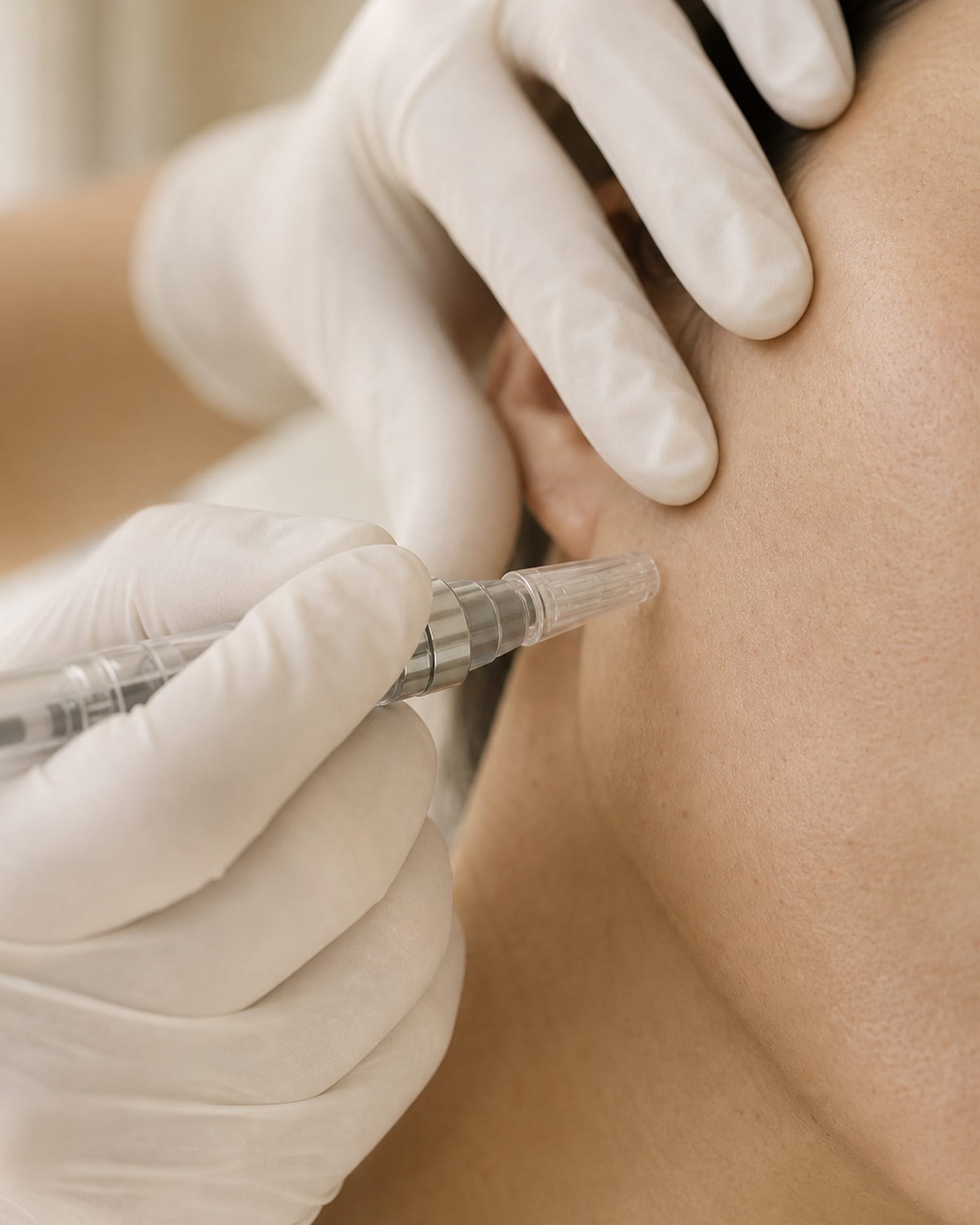
Releasing a scar that is tethered. In subcision, a needle is passed beneath the scar and moved sideways to divide the fibrous bands anchoring it to the tissue below. Released from that anchor, the depression can lift. This is the group of scars that energy devices reach their limit on — no amount of collagen stimulation raises a floor that is still tied down — and it is worked across the full face in one session rather than scar by scar.
Placing a medicine at one point. An inflamed acne lesion, the deep and painful kind that has not come to a head, can be settled with a small injection of an anti-inflammatory into the lesion itself. A raised or keloid scar is injected with the same class of medicine to flatten it, usually across repeated sessions. And hyaluronic acid filler can be broken down by an enzyme injected into the area holding it, whether that filler was placed here or elsewhere. All three are prescription medicines, and the doctor gives them after assessing you.
- Hyaluronic acid is broken down by a specific enzyme. Fillers built from other materials, including the longer-lasting biostimulatory kinds, are not affected by it.
- Any removal leaves a mark of some kind. The aim is that what remains reads as less noticeable than the lesion was, not that nothing remains.
- In Asian skin a treated site commonly goes darker, or lighter, than the skin around it for a period afterwards. It usually settles, but the timescale is months rather than weeks.
- Moles can regrow where the removal did not reach all of the tissue. Skin tags can appear at new sites. Milia recur readily in people who are prone to them. None of that means the procedure was done badly — it means the underlying tendency has not changed.
- Injections for raised and keloid scars almost always need repeating, and the injected site can end up thinner or lighter than the skin around it. That is a known trade-off rather than a rare surprise.
- An anti-inflammatory injection into an acne lesion can leave a small dip at the injection point, because the medicine that settles the inflammation can also thin the tissue locally. It usually fills back in over months. We use the smallest amount that will do the job, and we would rather you knew this in advance.
- Dissolving filler is not a tidy undo, and it is not always one visit. The enzyme is not selective, so some of the hyaluronic acid your own skin holds is affected too, and the area can look flatter than you expected before it settles.
- Subcision bruises and swells, firm lumps can appear at treated points while it heals, and tethered scarring commonly needs more than one session.
- A pigmented lesion that is changing — in size, shape, colour or border, or that bleeds or itches — is a medical question before it is a cosmetic one. We assess it and refer you rather than treating it for appearance.
Both are possible, and we would rather set that out now than afterwards. A mole whose removal did not reach all of the tissue can regrow; if it does, we look at it again rather than simply repeating what was done. Skin tags can appear at new sites, because whatever produced the first one has not changed.
As for a mark: every removal leaves something. The aim is that what is left sits flat and reads as less noticeable than the lesion did. In Asian skin the site commonly goes darker or lighter first, and that phase is counted in months.
Yes, and it is the part of the appointment that matters most. The doctor examines a pigmented lesion before anything is done to it. A lesion that has changed in size, shape, colour or border, or that bleeds or itches, is a medical question first.
Where there is doubt, we do not remove it for appearance. We refer you for proper assessment. Vaporising a lesion also destroys the tissue that would have answered the question, which is exactly why the order has to be assessment first and removal second.
Often, yes. Most of these take minutes, and where the doctor is satisfied at the assessment it can be done the same day. That is the practical appeal of this group of procedures.
Not always, though. If a lesion needs medical assessment first, if the area is inflamed or infected, or if you take medication we need to account for, we will assess and schedule rather than proceed. We would rather tell you that at the start than partway through.
They look similar and are handled completely differently. A whitehead is a blocked pore — it is acne, it has an opening to the surface, and it responds to acne treatment. A milium is keratin sealed inside a tiny cyst with no opening at all, which is why no topical product and no amount of squeezing will bring it out.
That is also why milia are opened and lifted out rather than extracted like a comedone, and why people who are prone to them tend to form new ones regardless of how well the first ones were removed.
Yes, and we do it. What we need first is an assessment of what was used and roughly when. That is not a formality: the enzyme breaks down hyaluronic acid and only hyaluronic acid. Fillers built from other materials, including the longer-lasting biostimulatory kinds, are not dissolved by it, and no dose changes that.
If you do not know what you had, we work from what the area looks and feels like, and we tell you what we can and cannot establish from that. Where the material is not hyaluronic acid, dissolving is not the answer and we will say so rather than attempt it.
It is also worth knowing that dissolving is not a clean undo. The enzyme also affects some of the hyaluronic acid your own skin holds, so the area can look flatter than you expect for a period, and more than one session is sometimes needed. We reassess before deciding whether anything further is done.
Your consultation will determine this. Skin type, medical history, medications and the changes you would like to see all affect which treatment is appropriate, and whether any treatment is suitable at all.
If a treatment isn't suitable for you, you'll be informed.
Your first visit includes a consultation where the doctor examines your skin and determines if this treatment is suitable for you before proceeding with any procedures. You don’t need to book the consultation separately.
If you prefer to come in solely for an assessment, our consultation charge is $80. However, if you decide to proceed with treatment on the same day, this fee will be waived.
The doctor will examine your skin, take your medical history and give you a detailed account of your skin condition, which may differ from your initial expectations.
You leave with a written plan and the associated costs. If a treatment isn’t suitable for you, you’ll be informed of that instead.
There’s no same-day price or deadline attached to the plan. Prices don’t change based on when you decide.
The plan is yours to keep. If you’d like more time to consider or make comparisons, that’s perfectly fine. We respect every customer’s decisions.