What this treatment addresses
Skin concerns we address

Scalp Condition
Flaking, oiliness and irritation

Recovery Support
LED runs as a step after other treatments

Thinning Concerns
Assessed first, and referred where a medical cause is likely

Maintenance
Alongside medical treatment managed by a doctor
Hair & Scalp Care
Your physician confirms the plan and its cost during your consultation. No pressure.
Not sure where to start? Your first visit is $88 nett — includes doctor's assessment, skin analysis and a first treatment.
Message us on WhatsApp and our team will arrange your visit. You can also call us at (+65) 8014 8552 for booking or any enquiries.
Operating hours: 10:30am–8pm daily
- Doctor’s assessment prior to treatment
- MOH-licensed medical clinic
- Tang Plaza, Orchard
- Transparent Pricing
Hair thinning has many causes, and some require medical evaluation before any treatment. Your assessment will determine the appropriate approach.
A topical scalp programme paired with LED phototherapy, directed at the condition of the scalp itself. This is not a treatment for medical hair loss.
- Suited To
- Thinning concerns, assessed first|Scalp condition & oil balance
- Technology
- Topical scalp programme + Healite LED phototherapy
- Downtime
- None
- Sensations
- Gentle massage and warmth|LED adds no sensation at all
- Performed By
- Therapist (doctor-directed)
- Sessions
- As a course, commonly six sessions
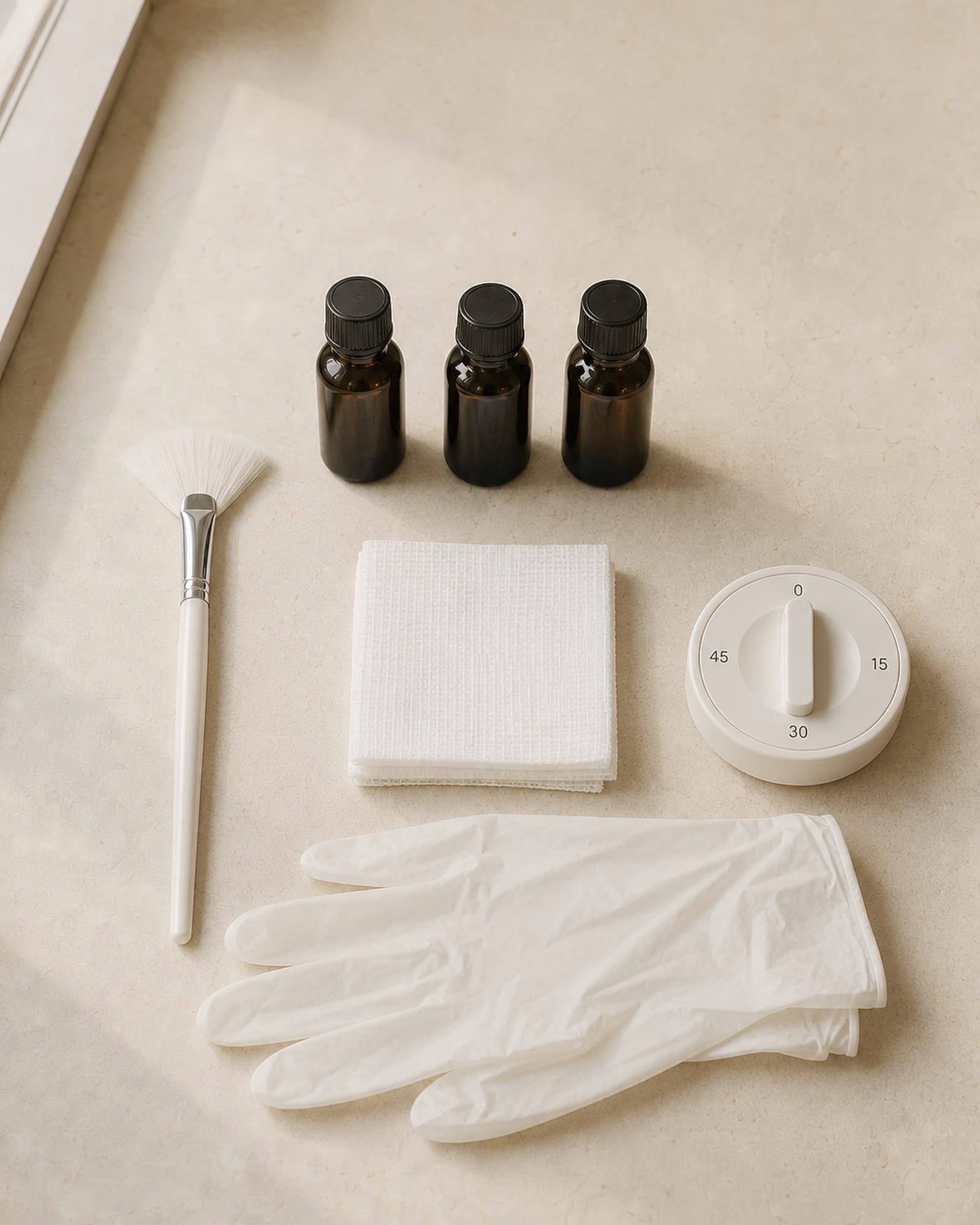
The scalp programme treats the scalp as skin. The surface is cleansed and surface build-up loosened, a professional topical preparation is applied along the partings, and the scalp is massaged. A therapist performs it under the doctor's direction, and it is planned as a course rather than as a single visit.
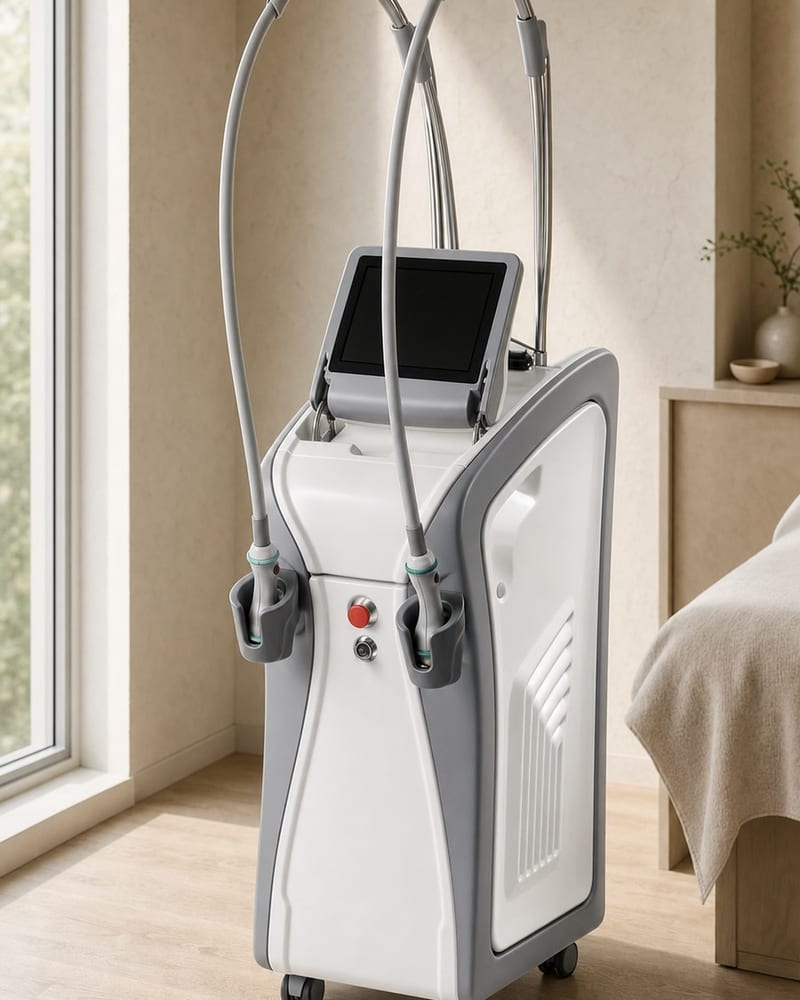
LED phototherapy delivers non-coherent light at selected wavelengths. Light at those wavelengths is absorbed by chromophores inside cells; that absorption is the whole of the mechanism. We use it for comfort and recovery after other treatments, and as an added step on the scalp. It is an adjunct in our hands rather than the main event, and we would rather describe it that way than imply more.
Hair loss itself divides into categories that behave differently. Androgenetic loss is driven by genetics and hormones and tends to progress. Telogen effluvium follows a stressor, an illness, a crash diet or childbirth, and the shedding shows up some months later. Scarring alopecias destroy the follicle itself. Thyroid disease and nutritional deficiency cause thinning of their own. Each of these has its own medical pathway, and scalp care is not one of those pathways.
What scalp care is reasonably for: a scalp that is oily, flaking or irritated; support alongside medical treatment that a doctor is already managing; and people who do not want medication and want the scalp itself kept in good condition. If you are in one of those groups, this is a sensible thing to do. If you are not, we will tell you at the assessment.
- This is scalp care. If what you have is androgenetic hair loss that is progressing, the treatments with the strongest evidence behind them are medical ones, prescribed and monitored by a doctor — and this is not one of them. We will tell you that at the assessment rather than sell you a course.
- Shedding that began suddenly, loss in defined patches, or loss accompanied by itching, pain or visible scarring of the scalp needs a medical assessment before anything cosmetic.
- Hair grows at roughly a centimetre a month. Any change in your hair is therefore read over months, and any description of hair change measured in weeks is not consistent with how hair grows.
- If you want to judge it for yourself, photograph the same parting in the same light every few weeks. An impression of thickness is unreliable; a photograph taken under consistent light is not.
- A course does not change whatever is causing the loss. It changes the condition of the scalp.
- The LED step is an adjunct. It can be booked on its own, but it is more often a step added to something else.
- We do not work on a scalp with an active infection or broken skin, and we screen for medications that increase sensitivity to light.
- Our treatment list carries this under a Chinese name that reads as hair-growth care (生发护理). We have left the name alone so that your quotation matches this page — but the description above is the accurate one, not the name.
No, and we would rather give that answer in one word than qualify it. This is a scalp programme. It works on the condition of the scalp — build-up, oiliness, irritation — and it is a reasonable thing to do alongside medical treatment, or on its own where the scalp itself is the problem.
Hair loss that is progressing has medical causes and medical treatments, and those are prescribed and monitored by a doctor. If that is what you have, the honest recommendation is to see one, and that is what we will say at your assessment.
Some patterns are worth a medical assessment before anything cosmetic is considered. Any of the following is a reason to be examined rather than booked:
- Shedding that started suddenly, or that is heavy every day.
- Loss in defined patches rather than diffuse thinning.
- A scalp that itches, burns, hurts, or looks red or scaly.
- Areas where the scalp looks smooth and shiny with no follicle openings visible.
- Thinning alongside fatigue, weight change, or a recent illness, pregnancy or crash diet.
- Thinning that is steadily progressing rather than holding steady.
Longer than most people expect. Hair grows at roughly a centimetre a month, and a hair entering its growing phase today is not visible as length for months. Anything affecting hair — including whatever caused the loss in the first place — reads out on that timescale rather than a weekly one.
The scalp itself is quicker. Oiliness and flaking respond sooner, and that is usually what people notice first.
Comfort and recovery after other treatments, mainly, and as an added step on the scalp. It can be booked on its own, though it more often runs as a short stage at the end of another appointment.
We are deliberately not making a claim about what it does for hair. Where we cannot cite something, we would rather leave it unsaid.
Your consultation will determine this. Skin type, medical history, medications and the changes you would like to see all affect which treatment is appropriate, and whether any treatment is suitable at all.
If a treatment isn't suitable for you, you'll be informed.
Your first visit includes a consultation where the doctor examines your skin and determines if this treatment is suitable for you before proceeding with any procedures. You don’t need to book the consultation separately.
If you prefer to come in solely for an assessment, our consultation charge is $80. However, if you decide to proceed with treatment on the same day, this fee will be waived.
The doctor will examine your skin, take your medical history and give you a detailed account of your skin condition, which may differ from your initial expectations.
You leave with a written plan and the associated costs. If a treatment isn’t suitable for you, you’ll be informed of that instead.
There’s no same-day price or deadline attached to the plan. Prices don’t change based on when you decide.
The plan is yours to keep. If you’d like more time to consider or make comparisons, that’s perfectly fine. We respect every customer’s decisions.