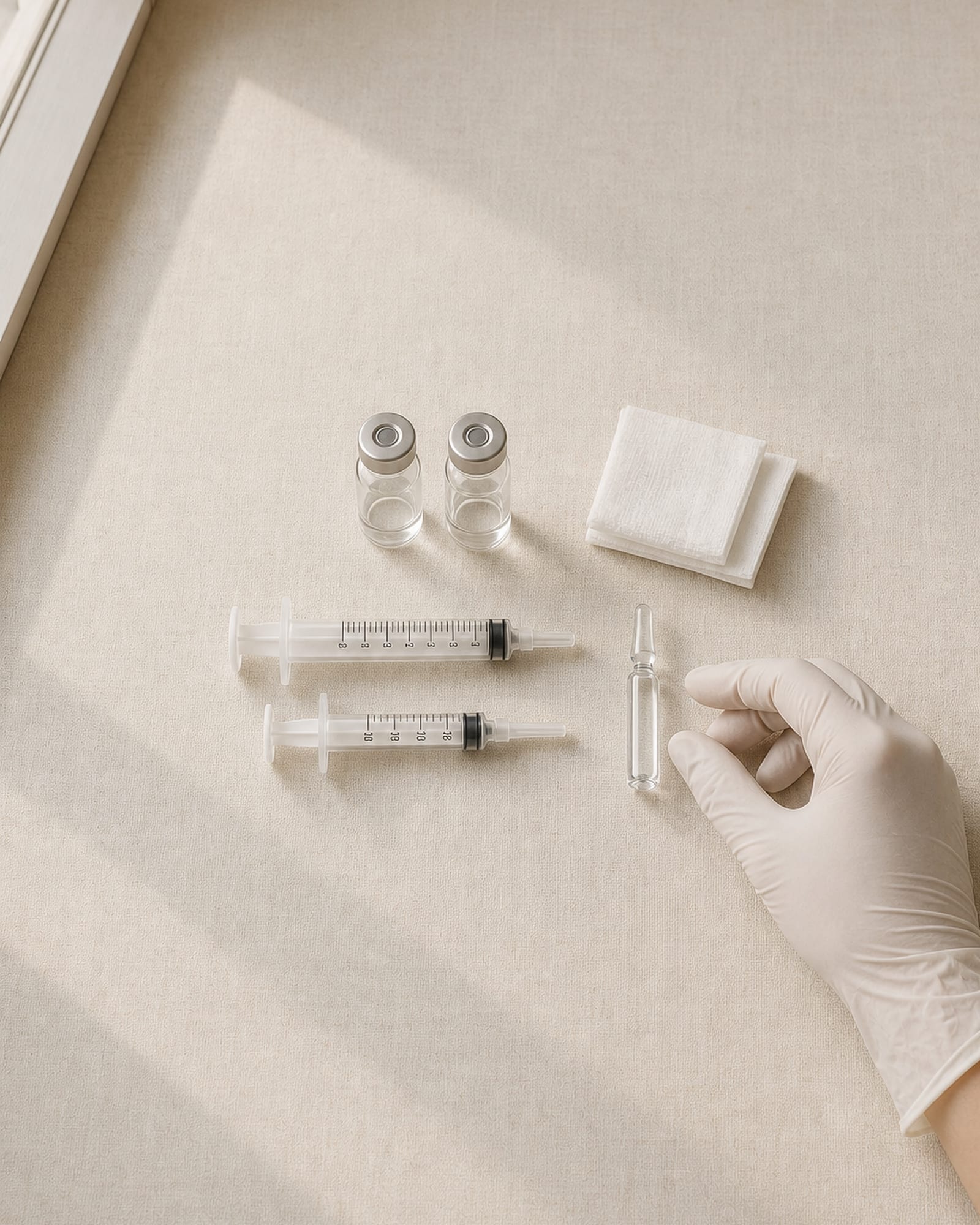
What this treatment addresses
Skin concerns we address

Volume Loss
Restores support where fat pads have shrunk

Facial Contour
Definition at the cheek, chin and jaw angle

Static Folds
Lines present when the face is at rest

Under-Eye Shadow
Often a support problem in the cheek rather than the tear trough itself
Hyaluronic Acid Fillers
Your physician confirms the plan and its cost during your consultation. No pressure.
Not sure where to start? Your first visit is $88 nett — includes doctor's assessment, skin analysis and a first treatment.
Message us on WhatsApp and our team will arrange your visit. You can also call us at (+65) 8014 8552 for booking or any enquiries.
Operating hours: 10:30am–8pm daily
- Doctor’s assessment prior to treatment
- MOH-licensed medical clinic
- Tang Plaza, Orchard
- Transparent Pricing
The whole class can be dissolved if ever needed, which is a safety property rather than a footnote.
A gel placed to restore the support the face has lost, not to add volume for its own sake. Three firmness grades for different jobs.
- Suited To
- Volume loss & hollows|Tear trough, assessed conservatively|Static folds|Contour support
- Technology
- Cross-linked hyaluronic acid gels in three firmness grades
- Downtime
- Swelling and possible bruising for several days
- Sensations
- Pressure and brief stings|Most gels contain a local anaesthetic
- Performed By
- Doctor
Hyaluronic acid is a sugar molecule that occurs naturally in skin and binds water. Cross-linked into a gel, it holds its shape and can be placed to support a hollow, a groove or a flattened contour.
Facial ageing is substantially a loss of support — fat pads shrink and descend, and bone remodels. Placing material back into those specific compartments addresses the cause of a shadow rather than the shadow itself.
We work with cross-linked gels of differing firmness, and the choice is about the area rather than a preference. A firm gel placed deep against bone gives support and projection. A gel with more give is used where the tissue moves, so that it integrates with expression instead of sitting against it. A finer gel is used in thin skin, such as the tear trough, and where an edge or a transition needs definition rather than volume.
Hyaluronic acid fillers can be dissolved with an enzyme. That reversibility is a meaningful safety property, and it is not only theoretical here — dissolving is a procedure we perform in its own right.
- Bruising is a real possibility, particularly around the eyes. If you have an important event, leave two weeks.
- The under-eye area is among the least forgiving places to inject. We are deliberately conservative there, and in some cases we will advise against it — sometimes the honest answer is that the shadow is better addressed by supporting the cheek, or not addressed at all.
- Filler placed to chase a line without addressing lost support tends to look wrong. Assessment of the whole face is part of the treatment, not an upsell.
- Dissolving is available, including for filler you did not have placed here. It is not a tidy undo: the enzyme also affects some of your own hyaluronic acid for a period, and the area is reassessed before anything further is done.
- Rare but serious complications exist, including vascular occlusion. This is a substantial part of why the treatment is doctor-only and why we take history and anatomy seriously.
- Not suitable during pregnancy or breastfeeding, or with active infection at the site.
Obvious results usually come from too much material, or from material placed to chase a line rather than to restore support. Our default is to treat less than the maximum and review, rather than to fill everything in one visit.
Hyaluronic acid can be broken down with an enzyme, area by area, and we perform this ourselves. It is one reason this class is the one most commonly used.
It is worth knowing what dissolving actually involves. The enzyme is not selective, so some of the hyaluronic acid your own skin holds is affected for a period as well, and the area usually looks a little flat before it settles. We reassess before deciding whether to place anything again.
Your consultation will determine this. Skin type, medical history, medications and the changes you would like to see all affect which treatment is appropriate, and whether any treatment is suitable at all.
If a treatment isn't suitable for you, you'll be informed.
Every plan is assessed by our doctor. Treatments that require a doctor are performed by the doctor; treatments that may be delegated are performed by trained therapists under the doctor's direction. We will tell you which applies before you book.
Your first visit includes a consultation where the doctor examines your skin and determines if this treatment is suitable for you before proceeding with any procedures. You don’t need to book the consultation separately.
If you prefer to come in solely for an assessment, our consultation charge is $80. However, if you decide to proceed with treatment on the same day, this fee will be waived.
The doctor will examine your skin, take your medical history and give you a detailed account of your skin condition, which may differ from your initial expectations.
You leave with a written plan and the associated costs. If a treatment isn’t suitable for you, you’ll be informed of that instead.
There’s no same-day price or deadline attached to the plan. Prices don’t change based on when you decide.
The plan is yours to keep. If you’d like more time to consider or make comparisons, that’s perfectly fine. We respect every customer’s decisions.